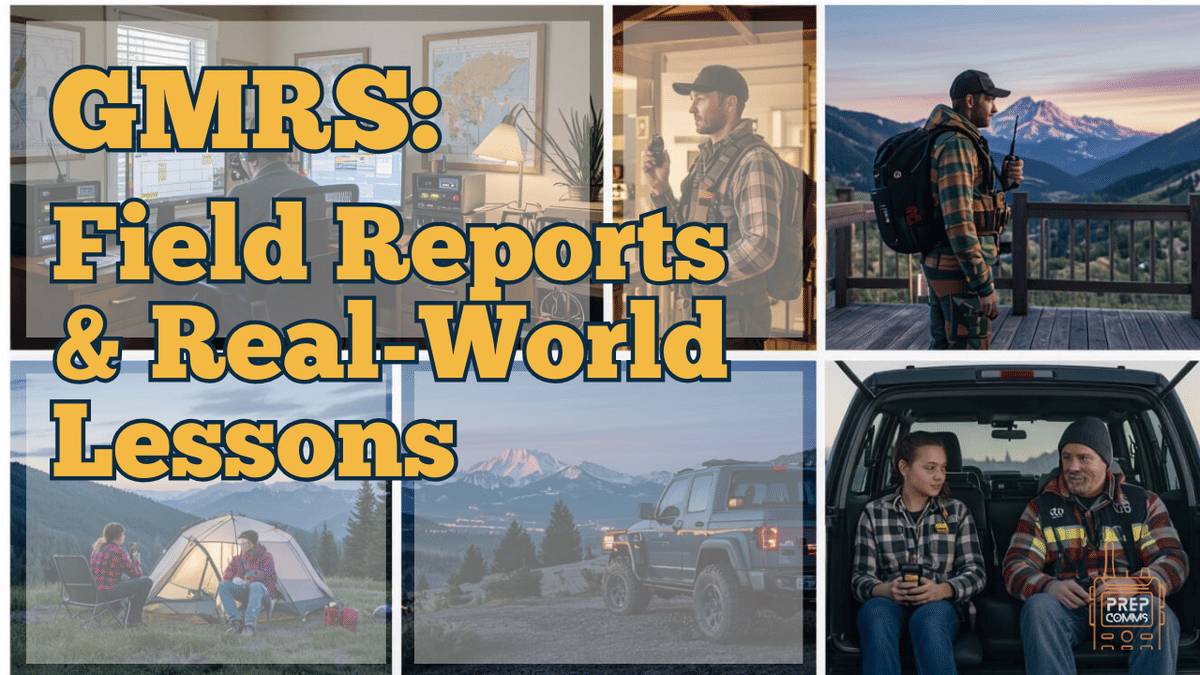
What Families and Operators Are Learning When They Put GMRS to Work
Every week I get messages, emails, and now YouTube comments from people who are taking what we’ve talked about here and putting it into practice.
Some of these reports are from families who’ve built simple systems that just work.
Others come from radio pros and public-service veterans who see the same principles playing out across mountains, farms, and small towns.
What follows isn’t theory. It’s field proof. (from GMRS Ep 2)
When Hurricanes Knock Out the Phones
@4given-c5h wrote in about Hurricane Helene.
“Having GMRS during and after the storm would have been so helpful.
Local repeaters were passing road closures, gas station info, and which ones still took cash.”
That’s what GMRS was built for — real, neighborhood-level intelligence when the normal systems blink out.
You don’t need a thousand-dollar setup, but you do need elevation and a clear path.
A good antenna on a decent mast will beat an expensive handheld every time.
Range Is Earned, Not Promised
@adambatchelder4121 checked in from the Sierra Nevada mountains in California.
“We’ve got several repeaters and can commonly talk 75–100 miles through a repeater and 2–50 miles radio-to-radio depending on terrain.”
That range isn’t luck — it’s physics.
Height wins.
The more clear sky between antennas, the farther you’ll reach.
It’s the same rule whether you’re on a ridge in the Sierras or a hayfield in South Carolina.
Altitude, Not Attitude
A long comment from @jamesbrownmiller808 summed it up best:
“When you have a radio station at 10,000 feet, signals can travel hundreds of miles.”
He’s right.
When the upper Mississippi River flooded, Civil Air Patrol aircraft used an airborne repeater that covered half the country.
Power alone won’t do that. Altitude does.
That lesson applies to every family station.
Even a small push — an antenna from the porch roof to the chimney line — can double your reach.
Community Networks That Work
@philm695 wrote about the East Tennessee GMRS network — one of the best in the country.
Open, dependable, and respectful.
That’s what happens when operators build for cooperation instead of competition.
If you’re new to GMRS, check MyGMRS.com.
It lists repeaters across the U.S., access tones, and local groups willing to help new licensees get connected.
Gear That Gets It Done
Antenna and height still rule, but the right hardware helps.
These are the same pieces I use or trust in the field:
Wil-Coms Roll-Up J-Pole Antenna — Compact, rugged, and in stock now and shipping. Perfect for GMRS, MURS, or Ham.
→ Order at PrepComms.shopZBM2 QP Whip Antenna — Proven portable whip for mobile or base setups.
Use code PREPCOMMS for a discount.
→ zbm2industries.com / QP-WhipUHF Yagi Directional Antenna — For long-range point-to-point or repeater work.
→ Amazon Link
The Technical Reminders
Several listeners offered solid technical notes worth repeating:
Coax quality matters — cheap feedline can waste half your watts (use LMR400 or equivalent).
Train your family — everyone using your license should know the rules.
ID every fifteen minutes and at the end of a conversation.
Respect repeater owners; access is a privilege, not a right.
Why This Matters
@TerminalElement found the YouTube channel after listening to the podcast and shared:
“Your shows have a ton of value and I’ve been sharing them with people who need to hear this.”
That’s why we do this — to help families build confidence, one small piece at a time.
GMRS isn’t about gadget collecting; it’s about stewardship, communication, and calm when things wobble.
Takeaways
Height beats power.
Antenna quality beats brand names.
Practice beats panic.
Community beats isolation.
Next Steps
Listen to the full episode → PrepComms.com
THE FIRST 10 THINGS TO DO WITH A GMRS RADIO-Family Connect Mini-Book #2
Live Family Connect Webinar — Thursdays 7 PM ET (Replay Fri–Mon) → FamilyConnectSystem.com
Built by first responders. Trusted by families. Rooted in faith.
Caleb Nelson K4CDN | WRBR 237
Prep Comms Podcast — “73 y’all & God Bless.”
About the Author
Caleb Nelson (K4CDN) is a husband, father of five, and the founder of the Family Connect System—a practical, family-first approach to emergency communication. A veteran of FM radio and a licensed Amateur Radio Operator, Caleb draws on decades of real-world experience, including nearly ten years in the professional fire service as an Engineer and EMT.
He and his wife of over 25 years, Carla, homeschool their children and run a small business together—often with the help of their two loyal Goldendoodles. Whether he's writing, teaching, or talking on the airwaves, Caleb’s heart to serve and protect families is at the center of everything he does.
More from Caleb: