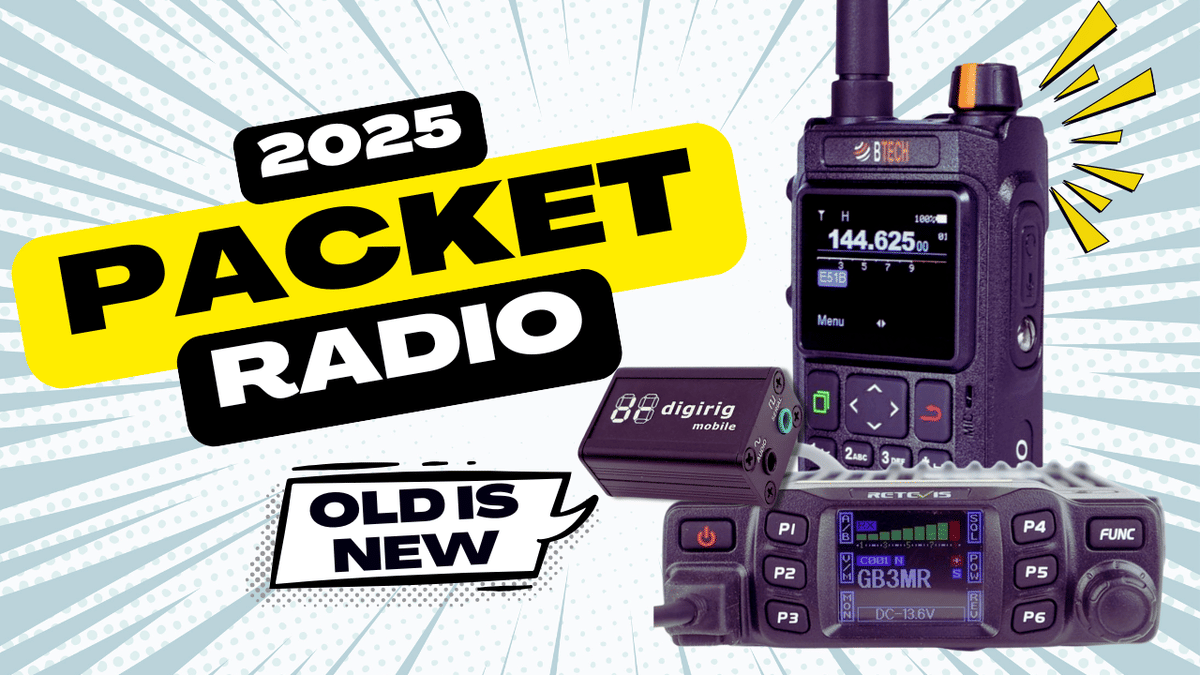
When people hear “packet radio,” most only know it as APRS dots on a map. And sure, APRS is packet — but it’s just the tip of the iceberg.
The truth is, packet used to be bigger. Back in the 80s and 90s, hams were moving messages, running bulletin boards, and sending digital traffic across RF. Then DSL and smartphones showed up, and seemingly the old-timers hung it up. Why bother with a TNC and serial cable when email and texting were so easy?
But here’s the catch: the internet is fragile. Phones drop, fiber breaks, and even the fastest networks can choke. That’s when packet suddenly makes sense again. It’s not new, but it’s relevant, resilant, and unlike the old days, today’s gear makes it easier than ever to get started.
You don’t need racks of equipment or hours of config files. You can build a packet station two simple ways:
The All-in-One Route – The UV-Pro with built-in Bluetooth KISS TNC, ready to connect straight to your phone or tablet.
The Modular Route – A budget radio like the RT-95, paired with a Digirig and UZ7HO SoundModem software, for maximum flexibility.
Packet radio isn’t dead. It was just left behind when shinier (easier) tech came along. Now, for preppers and families who want communication that doesn’t depend on the internet, it’s a tool worth pulling back into service.
Path 1: The All-in-One Route
If you don’t want to mess with extra boxes and cables, the BTech UV-Pro is about as clean as it gets.
Built-in KISS TNC with Bluetooth support
Pairs directly with packet apps (APRS, Winlink, etc.)
No Digirig, no wiring, no SoundModem software needed
Turn it on, pair it, and you’re passing packets. For families or operators who want reliability without the tangle of wires, this is the easiest modern option.
*If you'd like to spend more cash and have access to the 222MHz band the Kenwood Th-d75 HT will do the same at about 4x the cost.
Path 2: The Modular Route
If you’re more budget-minded or already have radios, you can still build a packet station with a few add-ons. A typical setup looks like this:
Radio Older VHF Mobile (Yeasu, Icom, Kenwood, ADI, etc...) or something new and low cost like the Retevis RT-95
Digirig Interface (acts as the sound card + PTT)
Correct cable for your radio model
Computer, tablet, or phone running the TNC software
On the software side, I recommend UZ7HO SoundModem. It’s stable, easy to use, and handles 300–9600 baud. If you prefer something else, Direwolf is also a solid alternative.
This setup is a little more involved, but it’s flexible and works with a wide range of radios.
Other Gear You’ll Hear About
Mobilinkd TNC4 – Great portable Bluetooth TNC. Handy with Android phones.
Kantronics boxes – Old-school hardware TNCs that still do the job.
Raspberry Pi – Tiny, cheap computers that run packet 24/7 with projects like DigiPi.
In fact, my friend Andy has been working with the DigiPi, and he’s loving it. He’s had great success running a simple Pi-based packet setup that just sits there and works (as well as virtually every other radio mode too!). For the right person, it’s an awesome middle ground between modular gear and plug-and-play simplicity.
Wrapping It Up
The known secret is packet radio isn’t just for APRS trackers. With a modern radio like the UV-Pro, or a simple Digirig + software setup, you can send real messages when cell towers go dark.
It doesn’t take much to get started — just pick your path:
Want simple and clean? Grab the UV-Pro.
Want budget and flexible? Start with something like the RT-95 plus a Digirig and SoundModem software.
Want a dedicated 24/7 node? Follow Andy’s lead and set up a DigiPi — small, efficient, and surprisingly powerful.
Either way, you’ll have a working packet station that moves data when it counts.
I've put all the pieces together in a KIT on my Kit.co page
About the Author
Caleb Nelson (K4CDN) is a husband, father of five, and the founder of the Family Connect System—a practical, family-first approach to emergency communication. A veteran of FM radio and a licensed Amateur Radio Operator, Caleb draws on decades of real-world experience, including nearly ten years in the professional fire service as an Engineer and EMT.
He and his wife of over 25 years, Carla, homeschool their children and run a small business together—often with the help of their two loyal Goldendoodles. Whether he's writing, teaching, or talking on the airwaves, Caleb’s heart to serve and protect families is at the center of everything he does.
More from Caleb: