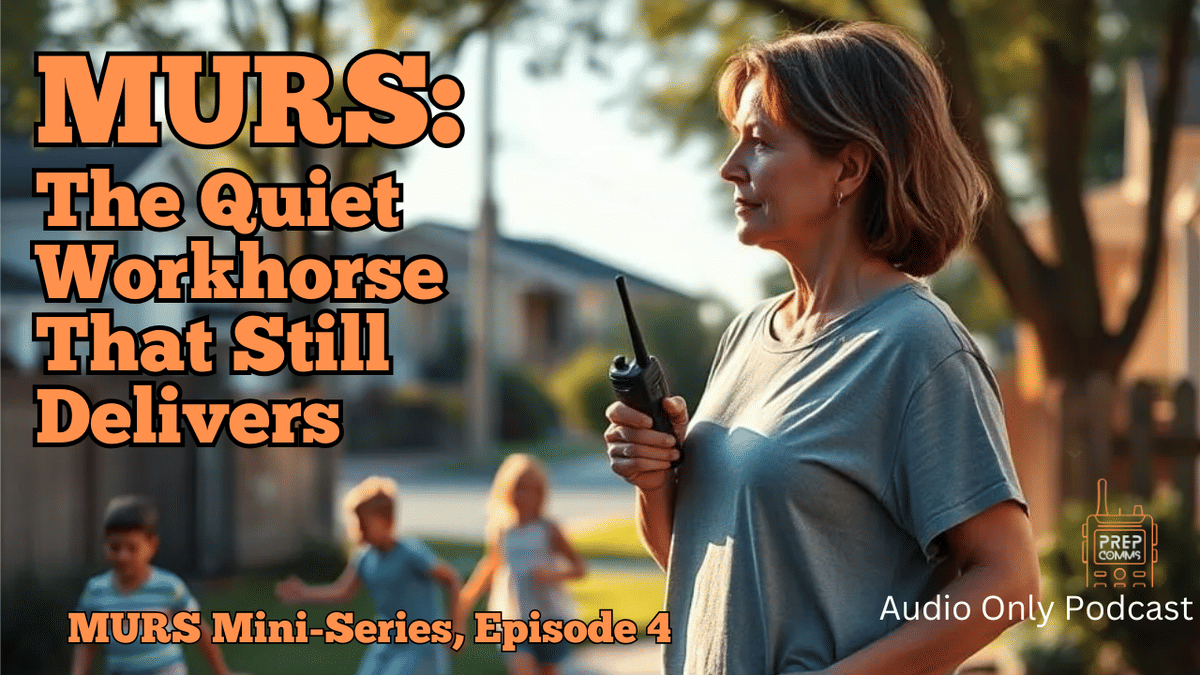
Why This Forgotten Band Might Be the Most Reliable Tool in Your Family’s Kit
What is MURS radio in 2025?
MURS is a license-free VHF radio service limited to five channels and two watts of power. It works best for short-range communication around homes, farms, and rural properties. It does not use repeaters. It is open for monitoring. When paired with proper antennas and realistic expectations, it remains one of the most practical local communication tools available.
For many families, MURS has been quietly doing the job for years. This unlicensed, underused radio service isn’t flashy, but it works. And if you’re trying to build a comms system you can trust, MURS might just be the best tool you’re not using.
Today we’ll unpack:
Real-world MURS performance from 15 years on my farm
Why antennas matter more than radios
How MURS stacks up against FRS, GMRS, CB, and ham
What makes it the right choice for some families
Let’s get into it.
Reliable, Quiet, and Farm-Tested
I’ve used MURS radios on our farm for over 15 years. Before we had ham licenses. Before GMRS. MURS was how we:
Got driveway alerts
Talked from house to barn
Managed in-vehicle comms on family trips
Stayed connected across our property
We used simple Dakota Alert base stations and basic handhelds. Nothing fancy. But they worked—and they still do.
The secret? Your antenna.
A good antenna, mounted high and paired with decent coax, will outperform any radio upgrade—every time.
Here are a few of the best antennas I’ve tested and trust:
ZBM2 QP Whip (Code: PREPCOMMS)
Don’t forget coax:
Is MURS Right for You?
MURS works great for:
Homesteads and farms
Families with kids or elders who need simple tools
Businesses like parking teams or event volunteers
Low-profile, low-traffic operations
It’s not the radio for ragchewing or calling out to strangers. But if you want quiet, local, and legal—it’s ideal.
Comparing MURS to Other Services
FRS: MURS has better range, audio clarity, and antenna flexibility
GMRS: GMRS has repeaters and more gear, but MURS wins on simplicity and no license fees
CB Radio: MURS is quieter, has shorter antennas, and less noise
Ham: Ham radio is more powerful, but MURS is far easier to adopt for the average household
Each has its place. But MURS holds its own.
Example of Old Radio Shack MURS Radio
Next Steps
If you’re ready to try MURS:
Buy gear that’s MURS-compliant
Set up a good antenna
Keep it simple—and stay legal
Amazon Storefront (MURS Gear)
Family Connect System
30/30 Ham Radio Challenge (if you've ever wanted to give it a go, but need a push!)
We’re closing the MURS mini-series here—but there’s plenty more ahead. Stay tuned for our upcoming dives into FRS, GMRS, and beyond.
Until next time—
Caleb Nelson, K4CDN
The Family Radio Guy
About the Author
Caleb Nelson (K4CDN) is a husband, father of five, and the founder of the Family Connect System—a practical, family-first approach to emergency communication. A veteran of FM radio and a licensed Amateur Radio Operator, Caleb draws on decades of real-world experience, including nearly ten years in the professional fire service as an Engineer and EMT.
He and his wife of over 25 years, Carla, homeschool their children and run a small business together—often with the help of their two loyal Goldendoodles. Whether he's writing, teaching, or talking on the airwaves, Caleb’s heart to serve and protect families is at the center of everything he does.
More from Caleb: