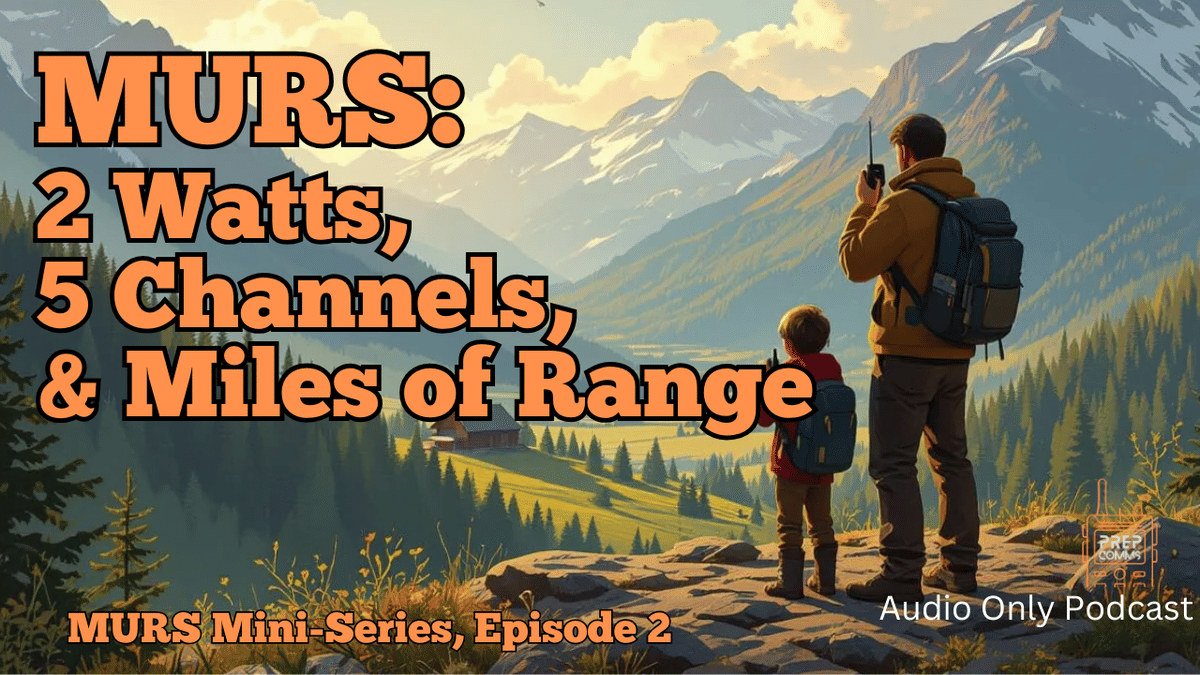
How far can MURS radio reach?
With stock handheld antennas, most users can expect one to two miles in typical terrain. With elevated or external antennas, range can increase significantly. MURS does not support repeaters, so coverage depends entirely on line of sight, terrain, and antenna height. Claims of extreme range without infrastructure are unrealistic.
For most folks, 2 watts doesn’t sound like much. Five channels? Sounds limited. And yet—across mountain ridges in Pennsylvania, down into rural valleys in Utah, and across barns and backyards all over the South—this little slice of spectrum continues to outperform expectations. Quietly. Consistently.
That’s the magic of MURS.
And in Episode 2 of our Prep Comms Podcast MURS Mini-Series, we crack open the real reason why it works so well—even with those supposed “limitations.”
Spoiler: It’s all about the antenna.
The Myth of Power—and the Reality of Performance
After Episode 1 dropped, the feedback came in fast. Folks from all over shared how they’re already using MURS—especially in rugged, rural areas where digital noise just doesn’t cut it.
One guy made a 100-mile simplex contact from Grandfather Mountain on 200 milliwatts. Not with fancy gear. Not with secret hacks. Just elevation, clean air, and smart setup.
Others noted how quiet MURS is—even when they leave it on all day. And that’s the point: Silence isn’t a bug. It’s a feature. When everyone else is fighting over noisy repeaters and congested CB or GMRS channels, MURS remains wide open and ready—especially for private family use.
What Makes MURS “Go the Distance”
We covered the basics of propagation and terrain, but this episode leans deep into hardware:
Antenna quality
Mounting height
Cable loss
System synergy
Here's what makes a real difference in your range—without ever breaking FCC limits.
Antennas That Make MURS Shine
These are the exact models we trust and recommend—whether they make us a commission or not. Because around here, I'd rather it work well for you than make a few cents from an AMZN link.
J-Pole MURS Antenna – JPole-Antenna.com
Hand-built and tuned specifically for the MURS band. This one performs beautifully as a backyard base or barn-top beacon.
Ed Fong DBJ-1C – GMRS & MURS Base Antenna
Built by students, tested by physics, and respected nationwide. Great for dual-service setups (GMRS + MURS).
Centerfire Dipole – Simple & Effective
Lightweight, easy to mount, and tuned for the wider VHF spectrum that MURS lives in.
Centerfire Ground Plane – Tunable VHF/UHF
Excellent choice for flexibility. Use it for MURS now and GMRS later.
Yagi Directional Antenna – Long-Distance Tactical
For fixed point-to-point installs—if you’re trying to talk to Grandma 9 miles away over 3 ridgelines, this is your move.
Comet GP-9NCA – High-Gain Vertical for MURS/GMRS
Tall, strong, and pricey—but if you need broadcast-grade height, this beast delivers.
ZBM2 QP Whip – MURS/GMRS Handheld Antenna
A serious whip for field use with big performance and rugged design.
Use code PREPCOMMS to save at checkout.
💰 Break-the-Bank Base Antenna
Yes, it’s expensive. But if you want premium build and finish—and extreme performance—this one earns its price tag.
Don’t Forget the Cable
For under 50 feet: Go with RG8x Low Loss Cable – inexpensive and simple.
For longer runs: Step up to LMR-400 or equivalent to reduce signal loss and keep your performance strong.
Remember, even the best antenna can’t fix junk feedline.
A Quick Note on Privacy
MURS is quiet. But it’s not encrypted.
You can’t make it private—. Just know that anyone with a scanner can technically listen in. So plan accordingly.
Want the Whole System?
If you’re ready to make MURS part of a real family communication plan—and not just a cool experiment—join the free on-demand webinar below:
➡️ Watch the Upcoming Free Webinar at www.FamilyConnectSystem.com
Learn how to build a reliable, grid-down communication plan in just 30 minutes—no tech expertise needed.
Final Word
This episode is all about the truth:
You don’t need more power. You need better setup.
MURS gives you that rare combo of legality, performance, and quiet operation that’s perfect for families who think ahead. And if you do it right—it’ll carry farther than you thought possible.
See you in the next episode as we tackle digital grey zones, driveway alerts, and why MURS repeaters aren’t a thing (legally speaking).
Until then—stay ready. Stay connected.
—Caleb Nelson, K4CDN
Prep Comms Podcast
Family Radio Guy
Ham Radio-Technician Privileges: What You Actually Get to Do
A lot of people treat the Technician license like it's a learner's permit. It isn't. In this episod...
Ham Radio: The Test..........
Ham radio testing is where a lot of people stall. Not because it's hard. Not because it's unfair. A...
Ham Radio: Why I Started the Journey
Ham Radio: Why I Started the Journey (and Where "Ham" Came From) Ham radio didn't start as a hobby ...
About the Author
Caleb Nelson (K4CDN) is a husband, father of five, and the founder of the Family Connect System—a practical, family-first approach to emergency communication. A veteran of FM radio and a licensed Amateur Radio Operator, Caleb draws on decades of real-world experience, including nearly ten years in the professional fire service as an Engineer and EMT.
He and his wife of over 25 years, Carla, homeschool their children and run a small business together—often with the help of their two loyal Goldendoodles. Whether he's writing, teaching, or talking on the airwaves, Caleb’s heart to serve and protect families is at the center of everything he does.
More from Caleb: