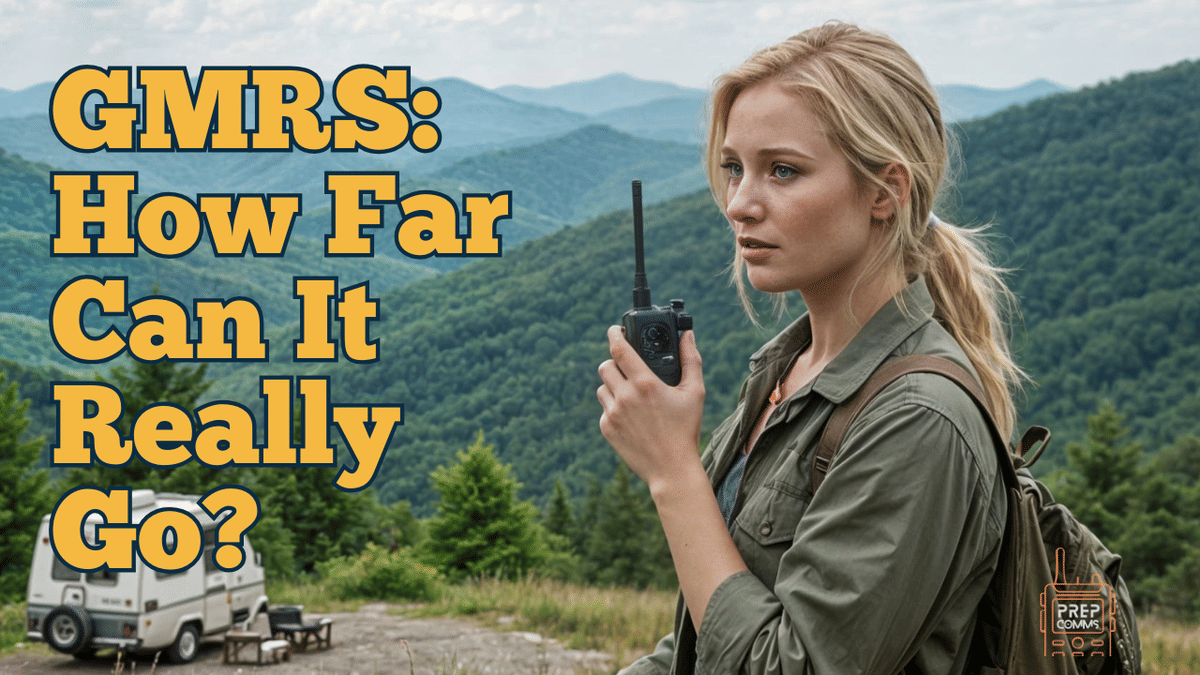
The truth about power, range, and what actually works for your family
Most GMRS radios come in a shiny box that promises “Up to 36 miles of range!”
If you’ve ever tried using one in the real world, you already know—those miles don’t exist.
The question most families ask after buying their first handheld is simple:
What can this thing really do?
Let’s find out.
Why GMRS Exists in the First Place
The General Mobile Radio Service—GMRS for short—was created to give families a private, short-range way to talk before we were all dependent on cell phones or the internet.
One license covers your entire household: you, your spouse, your kids, your parents, and even your in-laws. Everyone operates under one call sign, and the license lasts ten years.
It’s simple, affordable, and doesn’t require a test.
The trade-off? You’re responsible for every person who uses that license.
If they key up, you’re accountable. That’s the deal.
Power Helps, but Height Wins
GMRS allows up to 50 watts of power for mobile or base radios.
That sounds big, but it’s not the full story.
A 5-watt handheld with an antenna on the roof will outperform a 50-watt radio sitting on your lap.
Why? Because radio waves travel in straight lines. The higher your antenna, the farther your signal can see.
Think of it like a flashlight.
You don’t get more reach by turning up the brightness—you get more by climbing higher.
Here’s what the rules say (FCC §95.1767):
Mobile, base, and repeater stations: up to 50 watts
Fixed stations: up to 15 watts
Handhelds: usually 5 watts or less
After that, you’re fighting physics, not the FCC.
Marketing Miles vs. Real-World Range
Let’s get honest about distance.
Environment | Expected Range | Notes |
|---|---|---|
Urban neighborhood | 1–2 miles | Buildings and trees eat signal |
Suburban / small town | 3–5 miles | Decent terrain, moderate clutter |
Rural / open ground | 10–15 miles | Clear line-of-sight = best results |
With a repeater | 20–30+ miles | Depends on tower height and terrain |
Manufacturers print “50 miles” on the box because, technically, it can happen—from one mountain to another, perfectly clear air between.
For the rest of us, terrain and elevation decide everything.
If you want reliable communication, measure your own bubble—not what the package says.
Pick a clear day, send one radio down the road, and test where your signal fades.
That’s your family’s footprint.
The Secret Upgrade: Antennas
Every GMRS radio ships with a short “rubber duck” antenna.
It’s flexible, convenient—and terrible.
Half your power never leaves the radio.
Swap that antenna for one tuned for GMRS and elevate it even a few feet higher, and your range can greatly expand.
A few field-proven options:
ZBM2 QP Whip (use code PREPCOMMS)
Prep Comms-WilComs MURS/GMRS roll-up J-pole
Centerfire GMRS Groundplane for base setups
Others are listed in my Amazon store.
The rule is simple: height is horsepower.
Simplex vs. Repeaters
Most family use is simplex—radio to radio, same frequency.
It’s simple, fast, and doesn’t depend on infrastructure.
But if there’s a repeater nearby, your range can jump from a few miles to a few counties.
Repeaters sit high on towers or ridgelines. They listen on 467 MHz and re-transmit on 462 MHz.
That 5 MHz offset is what makes them work.
Remember, most are privately owned. Someone paid for the tower, the gear, and the power bill.
Use them respectfully: identify with your call sign, follow the local tone settings, and keep traffic short.
Next week’s episode digs deeper into this—how to find repeaters, how to use them, and how to build your own local link the right way.
Practical Takeaway
Upgrade antennas before buying new radios.
Don’t chase watts—chase height.
Learn your bubble before you need it.
Respect shared repeaters.
And keep your family practiced, not perfect.
That’s what real-world GMRS looks like.
Next Steps
Listen to the full podcast episode here → PrepComms.com
THE FIRST 10 THINGS TO DO WITH A GMRS RADIO-Family Connect Mini-Book #2
Join me live Thursday at 7 PM ET for the Family Connect System Webinar
Replay runs Friday–Monday → FamilyConnectSystem.com
—
Built by first responders. Trusted by families. Rooted in faith.
Caleb Nelson, K4CDN | WRBR237
Prep Comms Podcast —
About the Author
Caleb Nelson (K4CDN) is a husband, father of five, and the founder of the Family Connect System—a practical, family-first approach to emergency communication. A veteran of FM radio and a licensed Amateur Radio Operator, Caleb draws on decades of real-world experience, including nearly ten years in the professional fire service as an Engineer and EMT.
He and his wife of over 25 years, Carla, homeschool their children and run a small business together—often with the help of their two loyal Goldendoodles. Whether he's writing, teaching, or talking on the airwaves, Caleb’s heart to serve and protect families is at the center of everything he does.
More from Caleb: