A Plain-Language Guide for Real Families
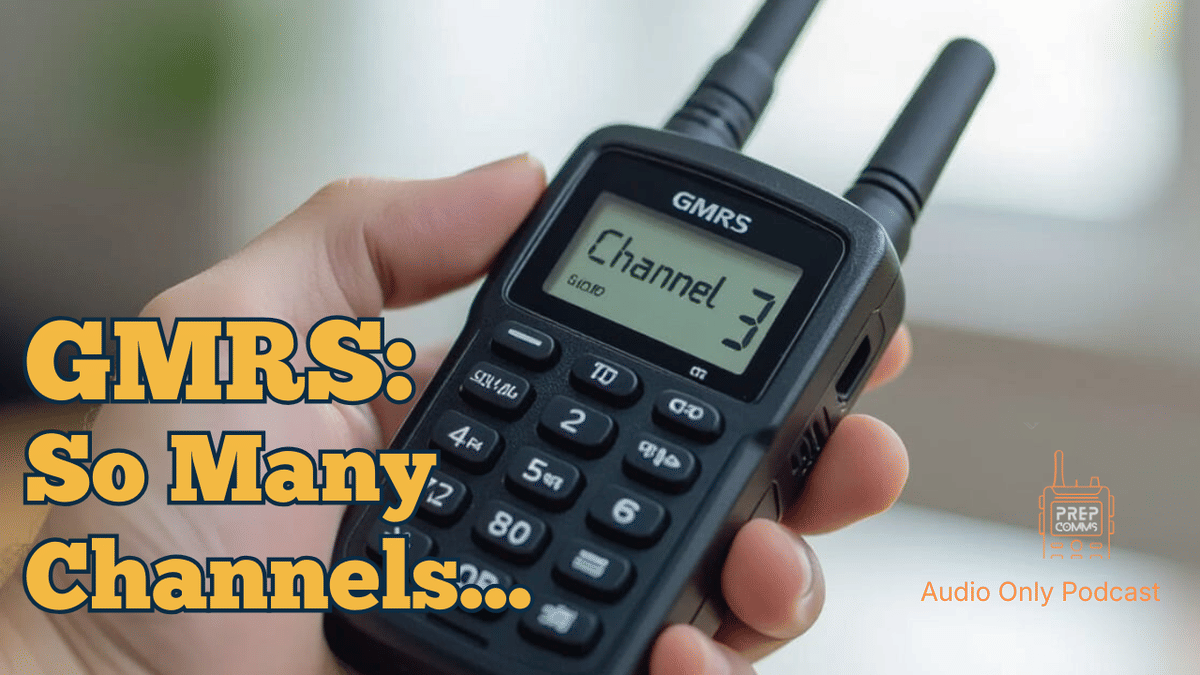
Most people get their first GMRS radio, spin the selector knob, and see the same thing:
Thirty channels.
All neatly numbered.
All looking equal.
And that’s where the trouble starts.
Because the truth is simple:
Some GMRS channels are workhorses. Some are limited. And some won’t carry your voice past the yard.
It isn’t the radio’s fault.
It isn’t the brand.
It isn’t the antenna.
It’s the FCC rulebook behind the service — and today we’re going to make sense of it in plain language.
This is Part 4 of our GMRS Series on the Prep Comms Podcast, and this might be the episode that finally removes the frustration most new users feel.
Why GMRS Feels Confusing at First
GMRS looks straightforward until you use it. Then things get messy:
Sometimes you get great range.
Other times the radio feels “dead.”
A family member on the same channel sounds like they’re behind a wall.
Some channels hit a repeater.
Some don’t.
Some allow full power.
Some run at half a watt.
And because all thirty channels look identical on the radio screen, families assume all thirty behave the same.
They don’t.
Let’s fix that.
The Only Three Groups That Matter
GMRS makes sense when you stop looking at the raw list and start looking at what each group can actually do.
1. Channels 15–22 — The Main GMRS Channels (50 Watts Allowed)
This is the heart of the service.
These channels allow:
Up to 50 watts of power
Repeater operation
External antennas
Base stations and mobile rigs
If you want to talk across town, across farmland, or through typical terrain, these eight channels are where the real range comes from.
This is where your household’s primary communication should live.
2. Channels 1–7 — The Interstitial Channels (5 Watts ERP)
These overlap with FRS.
They’re limited to:
5 watts ERP
Simplex only
Shorter range
These channels work well around the neighborhood, the campground, or the driveway. They’re clean and simple, but they’re not built for distance.
3. Channels 8–14 — Handheld-Only (0.5 Watts)
This is the part most people misunderstand.
Channels 8–14 are:
0.5 watt ERP
Handheld-only
Short-range by design
These channels are for tight, local communication — think kids in the yard or two people spotting a vehicle.
If your family uses these as “main channels,” GMRS will feel broken.
It isn’t.
You’re just using a low-power tool for a high-power job.
Repeaters: The Secret Engine of GMRS
GMRS has eight repeater pairs, all tied to Channels 15–22.
A repeater works like this:
Your radio sends a signal up to the repeater (on 467 MHz).
The repeater sends the signal down on the paired 462 MHz channel.
That’s how a handheld with a decent antenna can suddenly talk miles and miles.
If your area has an active GMRS repeater, it changes everything.
If it doesn’t, elevation and antenna quality become even more important.
The Three Channels Your Family Actually Needs
You don’t need all thirty channels to stay connected. You only need three:
1. Your Repeater Channel (15–22)
Whatever repeater you plan to use — teach your family this first.
2. Your Home Simplex Channel (15–22)
Pick one. Stay with it. Make it muscle memory.
3. One Local Channel (1–7)
This is for close-range use when everyone’s nearby.
That simple structure solves 90% of the confusion families experience.
A Quick Note About This Week’s Headlines
If you saw the news about the nationwide CodeRED outage, you already know why alternate communication plans matter.
A cybersecurity incident took the emergency alert system offline. Some counties couldn’t send weather alerts at all.
Events like that remind us why clarity and redundancy aren’t luxuries. They’re part of the job of protecting the people under your roof.
The Advent Calendar is here
Do you enjoy an Advent Calendar; how about one full of daily preparedness communications insights — it’s available here.
Wrapping Up
GMRS is powerful, simple, and family-friendly once you understand how the channels and power limits fit together. Most of the frustration people feel disappears the moment they learn what the channels were actually designed to do.
Next week, we’ll move into the practical side:
how to teach your family what to press, what to listen for, and how to get a message through when it matters.
Until then —
73 y’all & God Bless.
THE FIRST 10 THINGS TO DO WITH A GMRS RADIO-Family Connect Mini-Book #2
About the Author
Caleb Nelson (K4CDN) is a husband, father of five, and the founder of the Family Connect System—a practical, family-first approach to emergency communication. A veteran of FM radio and a licensed Amateur Radio Operator, Caleb draws on decades of real-world experience, including nearly ten years in the professional fire service as an Engineer and EMT.
He and his wife of over 25 years, Carla, homeschool their children and run a small business together—often with the help of their two loyal Goldendoodles. Whether he's writing, teaching, or talking on the airwaves, Caleb’s heart to serve and protect families is at the center of everything he does.
More from Caleb: